Solutions
Discover our solution for time registration, scheduling, and reporting

 Time & Attendance
 Planning
 Geolocation
 Reports
 Mobile App
 Project Clocking
Resources
Read our client stories, blog articles, and guides.
Solutions
Discover our solution for time registration, scheduling, and reporting
Resources
Read our client stories, blog articles, and guides.
Mandatory time tracking in Belgium from 2027: what to know

Belgium plans to introduce mandatory time tracking in 2027. While the legislation is still being finalised, employers can already review how they record working hours. What has been announced, which systems could meet the proposed requirements, and how can your business prepare? These seven key points explain what is known so far and what still needs to be confirmed.
7 key points on mandatory time tracking in Belgium
1. It stems from a European ruling. In 2019, a ruling by the European Court of Justice made clear that working time rules only work if hours are actually measured. Because of this, many EU countries started working on new legislation. The Belgian government followed up in its November 2025 budget agreement with a general time registration obligation, with a planned introduction in 2027 (announcement in French and Dutch). However, the final design is still not published.
2. It builds on existing law. Belgium's working time law already sets limits on working hours and rest periods. You can find it on the federal government's website in French, Dutch, and German. Mandatory time tracking is about how hours are recorded and proven, not about the limits themselves.
3. You choose the system. The draft legislation proposes the requirement of a system that records when and how long each employee worked, in a way that is objective and reliable. The article does not mention what such a system looks like.
4. What to look for in a time tracking system. As you prepare, look for a system that links records to the right employee, makes corrections traceable, and lets employees review their recorded hours. These are practical features to consider while the final Belgian requirements are being determined.
5. Schedules alone won't do. Some Belgian HR and payroll specialists say an existing work schedule may be acceptable, as long as every deviation from it is recorded accurately. Simply copying planned hours isn't enough. In practice, a schedule shows what was planned, not what actually happened, so every late start, extra hour, or skipped break has to be caught and corrected by hand. Recording actual hours as they happen is simpler, more accurate, and much easier to prove.
6. Recorded time isn't automatically working time. As Deloitte Belgium points out, the announced obligation is about recording hours, not about paying for every minute between clocking in and clocking out. An employee who clocks in early or stays to chat after their shift hasn't automatically worked overtime. What counts as working time still depends on labour law, contracts, and your own work rules, so it pays to set clear rules for breaks, early clock-ins, and overtime approval.
7. It calls for a more structured approach. For many businesses, mandatory time tracking in Belgium means replacing informal, trust-based tracking with records that show exactly when people worked. That shift pays off on its own: better visibility, fewer payroll errors, and fewer disputes. A good first step is to map which teams are affected most, such as remote staff, field workers, or employees on client sites.
How TimeMoto helps you get ready
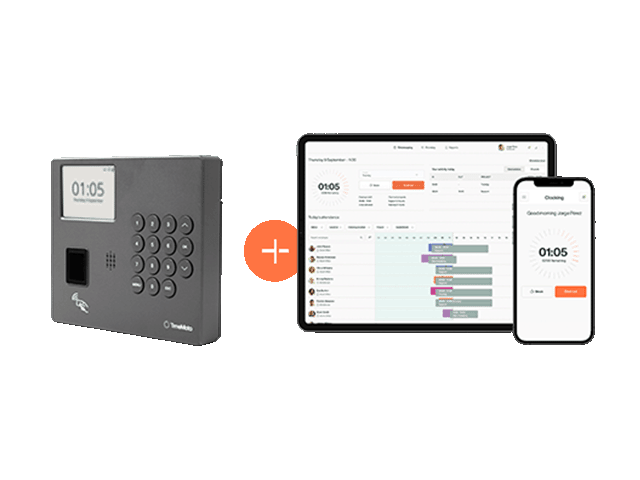
TimeMoto Cloud helps you build reliable time records, and supports time tracking compliance in EU countries that have updated their legislation after the 2019 European Court of Justice ruling. Employees clock in and out with an on-site Time Clock, the mobile app, or the web service. Hours, overtime, absences, and time off are recorded in one place, so payroll reports are ready when you need them.
Corrections are just as clear: every change leaves a traceable record, so you can always show what changed and who approved it. That means less admin, fewer errors, better control over labour costs, and a reliable overview of working time.
Start a free 30-day trial
Prepare for mandatory time tracking in Belgium, and get more out of your time records along the way. It all starts with the right system. Test TimeMoto in your own environment with your free 30-day trial and see how easy reliable time tracking can be.
Frequently asked questions about mandatory time tracking in Belgium
Is time tracking mandatory in Belgium from 2027?
In its November 2025 budget agreement, the Belgian government announced a general time registration in 2027 (announcement in French and Dutch). As of November 2026, the final legislation is still not published and timelines might shift, even though the general direction is clear: Belgium wants every employer to record the working time of their employees.
What is the new time tracking law in Belgium?
In their 2025 budget agreement, the Belgian government announced the introduction of mandatory time tracking for employers in 2027. The scope of the regulations is still being discussed. In the EU, it's a general obligation for employers to record working time, following a 2019 ruling by the European Court of Justice. Looking at other EU countries, we generally see that records must be objective, reliable, and accessible to both employees and labour inspectors.
Which companies must track working hours in Belgium?
Belgium’s announcement of the mandatory time tracking does not mention any exemptions. As the regulations are still being discussed, nothing is official yet. In their advice, social partners (employee and employer associations) are not fully aligned yet and even while exemptions have been discussed, the full scope of the new law is yet to be determined.
Do employers in Belgium need a time tracking system?
Belgium's working time law already sets limits on working hours and rest periods. Employers need a system that records working hours objectively and reliably. With the announced upcoming mandatory time tracking, this becomes even more important.
Is a clock-in terminal required in Belgium?
Belgium doesn't prescribe one specific system. The 2025 announcement only mentions a ‘simple and flexible’ solution. An on-site clocking terminal, a mobile app, and a web-based tool can all work, as long as the records are objective, reliable, and accessible. Many businesses combine them, for example a terminal on site and an app for remote staff.
How should companies in Belgium track working hours?
In general, it is recommended to use a system that records the hours actually worked, can't be changed without a trace, and is open for inspection. Working from a schedule might be allowed in the yet to be published mandatory time tracking regulations, but from a practical point of view this can only work if every deviation is recorded accurately. Simply copying planned hours is not enough. Recording actual hours with a dedicated time tracking system is the most reliable way to meet the requirements.
What are the risks of not tracking working hours in Belgium?
Employers who don't record working time might risk sanctions after new time tracking regulations are introduced. They already have a weaker position in labour disputes, because hours worked are hard to prove without reliable records.
Does the time tracking law in Belgium apply to remote workers?
Social partners have issued an advice to the Belgian government that covers certain exemptions including traveling staff and remote workers, but the scope of the law has yet to be determined.
When should companies in Belgium prepare for mandatory time tracking?
While mandatory time tracking is not officially introduced yet, now is a good moment to prepare. Choosing a system, setting up processes, and training employees takes time, so the earlier you start, the better.
Can Excel be used for time tracking in Belgium?
In theory, yes, if it meets the legal requirements. In practice, spreadsheets are easy to edit without a trace, which makes it hard to prove your records are reliable.
Sign up for the TimeMoto newsletter.
Get time on your side again with our newsletter. Sign up now and receive insights about managing your workforce, major trends, news and important product updates. Right in your mailbox.
By signing up you consent to receiving news and promotions via email from TimeMoto B.V. regarding TimeMoto products and services. You have the right to withdraw your consent at any time. For more information, please read our Privacy Statement.